Why is my jaw locking when I open my mouth — is it an emergency?
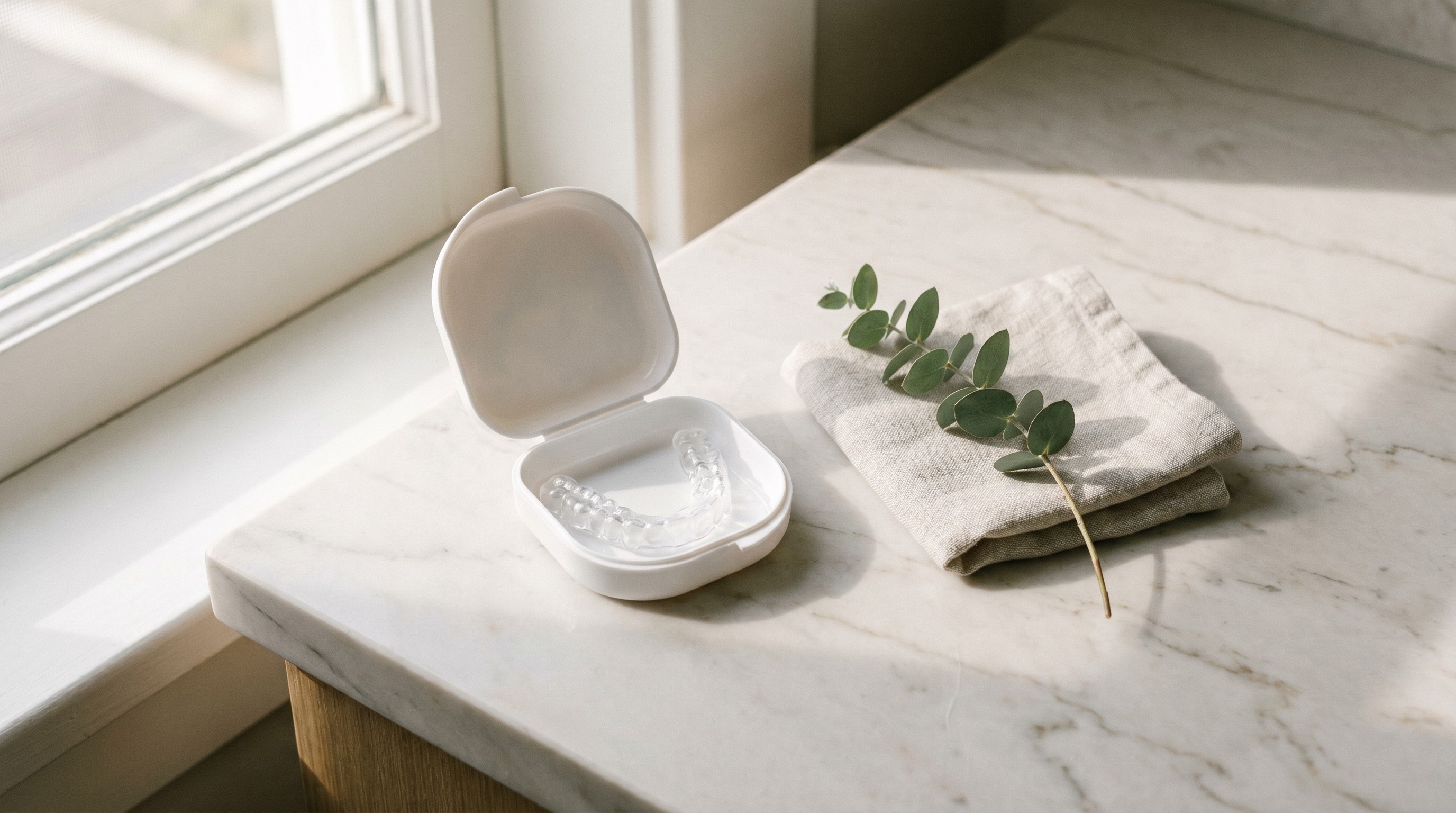
A jaw that locks open or closed and won't move is a dental emergency. Call your dentist the same day, especially if you can't fully close your mouth, can't open past a finger's width, or have severe pain. Brief clicks or mild stiffness that resolves on its own can usually wait, but recurring episodes deserve a TMJ evaluation.
At Line Dental Aloha, we hear this question more often than people might guess. A 34-year-old Intel engineer came in last month after her jaw locked open mid-yawn at her desk in Hillsboro. She thought she was having a stroke. She wasn't. It was a classic TMJ episode, and we walked her through what was happening within ten minutes of her arrival.
Here's how to tell what you're dealing with.
What does it mean when your jaw locks?
Your temporomandibular joint (TMJ) sits just in front of each ear. Between the ball of your jawbone and the socket is a small cushion called the articular disc. That disc is supposed to glide smoothly when you open and close. When it slips out of place, the jaw can get stuck.
There are two main types of lock:
Open lock: your mouth opens wide and won't close back down. Often happens during a big yawn, a long dental appointment, or biting into something tall like a burger.
Closed lock: your mouth won't open more than about a finger's width. The disc is jammed in front of the joint and blocking motion.
Both can happen suddenly. Both feel alarming. Neither usually means something is broken.
Is a locked jaw a true dental emergency?
Sometimes yes. Sometimes no. The distinction matters.
Call us the same day if you have any of these:
You cannot close your mouth at all
You cannot open past about 20 mm (roughly one finger width)
Severe pain that NSAIDs don't touch
Visible swelling around the joint or ear
The lock happened right after a blow, fall, or car accident
Numbness or facial weakness alongside the lock
Usually safe to wait 24 to 48 hours:
Mild morning stiffness that loosens up
Clicking or popping without pain
A brief lock that releases on its own within seconds
Soreness after a long dental procedure that's improving hour by hour
For a lock that follows head or jaw trauma, go to the ER first. They can rule out a fracture. For an isolated TMJ lock with no trauma, a dentist is the right call. Emergency rooms are not equipped to manually reduce a TMJ. We are.
What causes jaw locking in the first place?
The short answer: pressure and wear on a joint that was never meant to handle that much load.
The most common drivers we see at Line Dental:
Bruxism. Nighttime grinding and daytime clenching put hundreds of pounds of force through the TMJ. The American Dental Association links bruxism directly to stress and to TMD symptoms.
Disc displacement. The articular disc slips forward and gets stuck. According to the American Academy of Orofacial Pain, closed lock typically results from anterior disc displacement without reduction.
Wide-opening events. Yawning, singing, a long crown appointment, eating a thick sandwich.
Arthritis or prior trauma. Old injuries that healed poorly can leave the joint vulnerable.
Posture. Forward head posture from desk work shifts the jaw's resting position. We see this constantly in patients from the Intel Hillsboro and Nike Beaverton campuses.
The National Institute of Dental and Craniofacial Research estimates that temporomandibular disorders affect 5 to 12 percent of the population, with women and adults aged 20 to 40 most commonly affected. That maps almost perfectly onto our Highway 217 commuter demographic.
What can you safely do at home before seeing a dentist?
If your jaw is sore or stiff but still moving, try this for the next 24 hours:
Warm compress on the joint for 10 to 15 minutes, two or three times a day
Soft-food diet. Think yogurt, eggs, soup, soft pasta. No bagels, no apples, no jerky.
Restrict your opening. Cut food into small pieces. Cover your mouth and support your chin if you feel a yawn coming.
NSAIDs like ibuprofen, taken per the label, can reduce inflammation
Sleep on your back if you can. Side sleeping with a fist under the jaw makes it worse.
What not to do:
Don't force the jaw open or closed
Don't keep testing the click on purpose
Don't chew gum, even sugar-free
Don't ignore a lock that comes back twice in one week
Conservative care works. The ADA and Cochrane reviews of TMD treatment consistently put soft diet, jaw rest, NSAIDs, and night guards as first-line therapy before anything invasive.
How a dentist diagnoses and treats a locked jaw
When you come in, we measure your maximum opening with a small ruler. Normal adult opening is roughly 40 to 55 mm. Anything under 35 mm we consider restricted. We feel the joint as you open and close, listen for clicks or grinding, and check your bite.
For an acute closed lock that just happened, we can often perform a manual reduction in the chair. Hands on the lower molars, gentle downward and forward pressure, the disc usually slips back into place. Patients are often shocked at how quick it is.
For ongoing issues, treatment looks like this:
Custom night guard for grinders. Not the boil-and-bite kind. A precision guard made from your iTero scan.
Bite analysis to check for high spots or uneven contacts
Stress and habit counseling. Jaw posture, daytime clenching awareness, ergonomics for desk workers
Referral to an orofacial pain specialist or physical therapist for chronic or complex cases
Most patients improve significantly within weeks. Surgery is rare and almost never the first answer.
When to call Line Dental Aloha
If your jaw is locked right now and won't release, call us at (503) 259-8641. We hold same-week appointment slots for emergencies and serve patients across Aloha, Beaverton, and Hillsboro. Our office at 18425 SW Alexander St sits just off Highway 217, easy to reach from the Intel Ronler Acres campus, Nike World Headquarters, and the TV Highway corridor.
Dr. Paul Kyu Choi and Dr. Mijin Choi both see TMJ patients regularly. We also serve the Korean-speaking community in the Aloha-Beaverton-Hillsboro area, so language is never a barrier when you're describing what hurts.
You don't have to live with a jaw that locks. That's a promise.
Frequently Asked Questions
Can a locked jaw fix itself?
Sometimes, yes. A brief open lock from a wide yawn often releases on its own when you relax the muscles. A closed lock that lasts more than a few hours rarely self-resolves and usually needs hands-on care. If it happens twice in one week, get evaluated even if each episode passes.
Should I go to the ER or a dentist for a locked jaw?
Go to the ER if the lock followed head trauma, if you have facial numbness, or if you can't breathe or swallow normally. Otherwise, call a dentist. We are trained to reduce TMJ dislocations and treat the underlying joint problem. Most ERs are not, and they typically refer you back to a dentist anyway.
Why does my jaw lock in the morning?
Most likely nighttime grinding or clenching. You've been loading the joint for six to eight hours straight without realizing it. The muscles are tight and the disc may have shifted overnight. A custom night guard usually solves this within a few weeks.
Can stress really make my jaw lock?
Yes. Stress drives clenching, clenching tires the muscles around the TMJ, and tired muscles let the joint move in ways it shouldn't. We see jaw locking spike during big work deadlines, exams, and major life events. It's one of the most consistent patterns in our practice.
Will a night guard prevent jaw locking?For most patients, yes. A properly fitted custom night guard reduces clenching force, separates the back teeth, and gives the TMJ a chance to rest. Drugstore guards can sometimes make things worse by shifting your bite, so we recommend getting one made from a digital scan of your actual teeth.
Schedule Your Visit Today
At Line Dental, we understand that patients may have many questions before scheduling an appointment or visiting our office. Below are answers to some of the most frequently asked questions. If you have additional inquiries, please feel free to contact us at 503-259-8641 or via our online form.