Bone Grafting Before Dental Implants: When Is It Actually Needed?
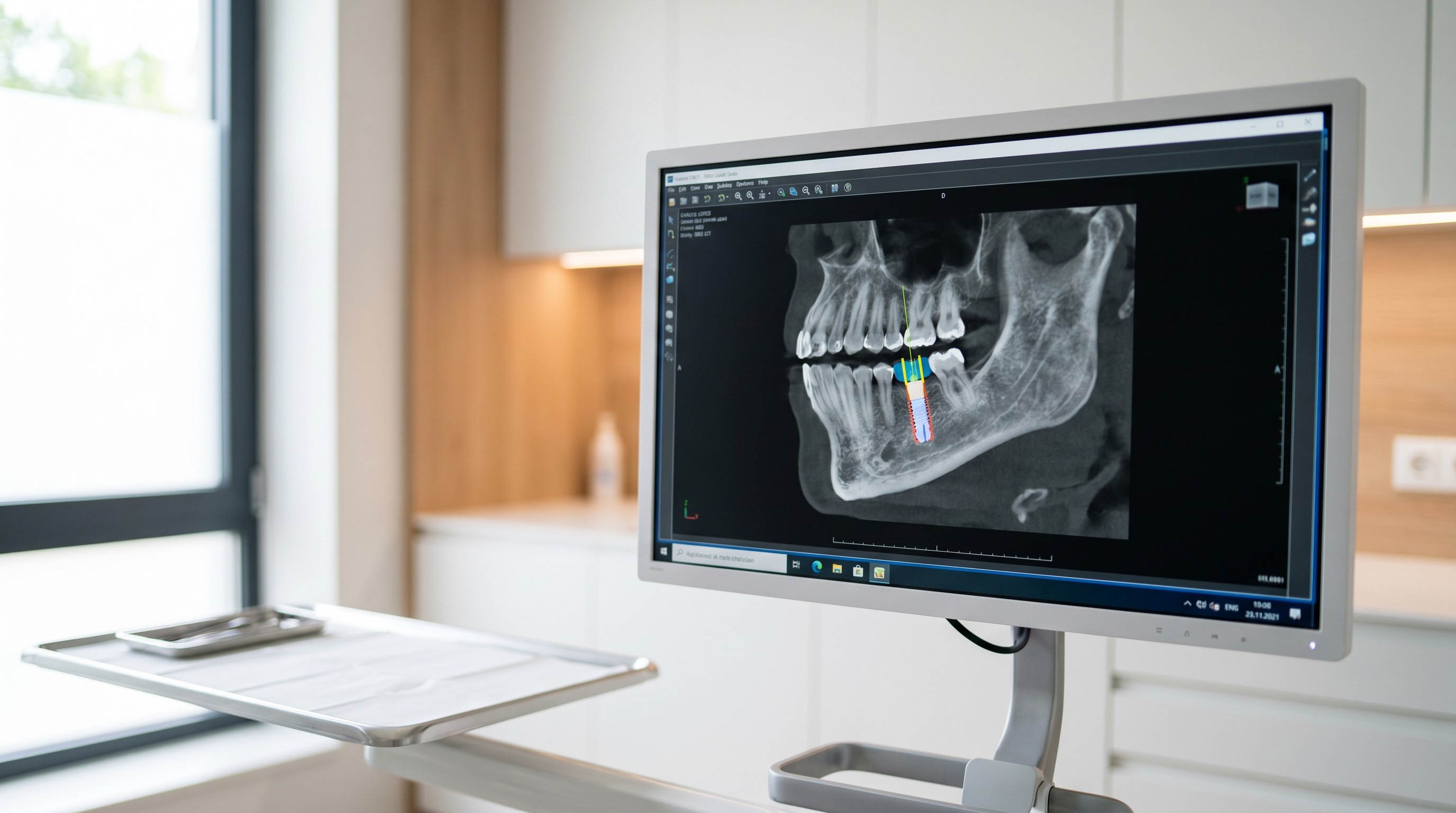
Bone grafting is needed before a dental implant when the jawbone lacks the height or width to securely hold the implant. Common situations include teeth lost years ago, extraction sites that have resorbed, upper back teeth near a dropped sinus, and bone loss from gum disease. A 3D scan confirms whether grafting is required.
At Line Dental Aloha, we hear this question almost every week. Patients come in ready to start implants, and then they learn there might be an extra step first. It feels like a setback. It usually isn't. A graft is the difference between an implant that holds for decades and one that fails in a year.
Here's the plain-English version of when grafting matters, why, and how to know if you'll need one.
Why does the jawbone matter for a dental implant?
A dental implant is a small titanium post that takes the place of a tooth root. The body actually fuses bone tissue directly onto the surface of the titanium. That process is called osseointegration, and according to the NIDCR and peer-reviewed implant literature, it typically takes 3 to 6 months depending on the site and the quality of the bone.
For that fusion to happen, two things have to be true: there has to be enough bone in height, and enough bone in width. Think of it like setting a fence post. The post needs deep, solid ground around it on every side. A shallow hole won't hold.
Here's the part most patients don't realize. The moment a tooth is removed, the body starts reabsorbing the bone that used to support it. According to a systematic review published in the Journal of Clinical Periodontology, the alveolar ridge can lose up to 50% of its width within the first 12 months after extraction if nothing is done to preserve it.
That's a lot of bone. Gone fast.
When is bone grafting needed before an implant?
There are five common scenarios we see at our Aloha office. Most patients fit into one of them.
Scenario 1: The tooth was lost years ago. If you've been living with a missing tooth for two, five, or fifteen years, the ridge underneath has likely shrunk. The cheek may even look slightly sunken in that spot. A graft rebuilds the volume so the implant has something to anchor into.
Scenario 2: An extraction is happening now. When a tooth comes out, we can place graft material directly into the socket at the same visit. This is called ridge preservation, and it keeps the bone from collapsing while the site heals. It's a small step that prevents a much bigger one later.
Scenario 3: An upper back tooth where the sinus has dropped. The maxillary sinuses sit just above the roots of the upper molars. When those teeth are lost, the sinus floor can expand downward into the empty space. According to AAOMS clinical guidelines, when the remaining bone height is less than roughly 4 to 5 mm, a sinus lift is usually required to add bone between the sinus floor and the future implant.
Scenario 4: Periodontal disease destroyed bone. Advanced gum disease eats away at the bone that supports the teeth. Even if the tooth is still there, the bone underneath may be too thin for an implant. Grafting rebuilds that foundation.
Scenario 5: Trauma or infection. A bad fall, a sports injury, or a long-standing abscess can hollow out a section of bone. The implant can't go in until that defect is filled.
A Korean-speaking patient in his fifties came to us from the TV Highway corridor recently. He'd lost an upper molar nearly a decade ago and assumed implants were off the table. A quick 3D scan showed he needed a sinus lift on that side, nothing more. Six months later, the implant went in beautifully.
What are the different types of bone grafts?
The word "graft" sounds bigger than it is. The material is usually just a small amount of granules placed where bone is missing. Four common sources:
Autograft. bone harvested from another site in your own mouth or body. Used for larger reconstructions.
Allograft. processed human donor bone from a tissue bank. The most common choice for routine cases.
Xenograft. bone from a bovine (cow) source, processed to leave only the mineral scaffold.
Alloplast. fully synthetic material that mimics natural bone structure.
Allograft and xenograft materials are processed and sterilized under FDA and American Association of Tissue Banks standards to remove any disease-transmission risk. They function as a scaffold. Your own body grows real, living bone into and through the material over the following months.
The choice depends on the size of the defect and the location. We walk every patient through which option we're recommending and why.
How long does healing take before the implant can be placed?
Timelines vary by case, but here's the general range:
Small socket grafts (ridge preservation): 3 to 4 months
Larger ridge augmentations: 4 to 6 months
Sinus lifts: 6 to 9 months before implant placement
Some cases allow the graft and the implant at the same visit. This is more common when the defect is small and the surrounding bone is healthy. A cone-beam CT scan (CBCT) tells us whether that's an option for you.
Patience pays off here. Implants placed into well-grafted bone have a long-term survival rate of approximately 95% over 10 years, according to peer-reviewed implant dentistry literature. That number drops sharply when implants are forced into bone that wasn't ready.
A graft is the difference between an implant that holds for decades and one that fails in a year.
How do I know if I'll need a graft before my Aloha implant consult?
You can't fully self-diagnose. A panoramic X-ray and a 3D CBCT scan are the only way to measure bone height, width, and density accurately. But there are warning signs that make grafting more likely:
The tooth was lost more than two years ago
A history of moderate or severe gum disease
A sunken or flattened appearance in the cheek or jaw area
A previous extraction that wasn't grafted at the time
Upper back teeth missing for any length of time
When you come in for an implant consultation at our Aloha office, we take the 3D scan first. Then we sit down and show you exactly what we see on the screen. If grafting is needed, we explain which type, how long it adds to the timeline, and what it costs. No surprises.
We serve patients across Washington County, from Aloha and Beaverton out to Hillsboro and the Intel and Nike campuses. Many of our Korean-American patients in the Aloha-Beaverton-Hillsboro area come to us specifically because Dr. Paul Kyu Choi and Dr. Mijin Choi can walk through every step in both English and Korean.
Frequently Asked Questions
Is bone grafting painful?
Most patients are surprised at how mild the recovery is. The procedure itself is done under local anesthesia, often with sedation if you prefer. Afterward, most people manage discomfort with over-the-counter ibuprofen for a day or two. Larger grafts may involve a bit more swelling, but the pain level is typically less than a tooth extraction.
Can I get an implant the same day as my extraction to avoid a graft?
Sometimes, yes. When the extraction site has healthy surrounding bone and no infection, an immediate implant is possible. In many cases we still place a small amount of graft material around the implant to support the surrounding ridge. A CBCT scan at consultation tells us whether you're a candidate.
How much does a dental bone graft cost in Oregon?
Costs vary widely depending on the size and type. A small socket preservation graft is typically a few hundred dollars. A sinus lift or larger ridge augmentation runs significantly higher. Many PPO dental insurance plans cover a portion when the graft is medically necessary for implant placement. Our team verifies your benefits before treatment begins.
What happens if I skip the bone graft and try the implant anyway?
An implant placed into insufficient bone is at high risk of failure. It may feel loose, become infected, or simply fall out months later. Worse, the failure can damage what bone remained, making future implant attempts harder. Skipping the graft when one is needed almost always costs more in the long run.
Are bone grafts safe? Where does the bone come from?
Yes. Donor and bovine graft materials are processed under strict FDA and tissue-bank protocols that eliminate disease-transmission risk. Synthetic grafts contain no biological material at all. Your body uses the graft as a temporary scaffold and replaces it with your own living bone over the following months.
Ready to find out if implants are right for you?
If you've been told you need a graft, or you're wondering whether you will, the answer starts with a 3D scan and an honest conversation. Call Line Dental Aloha at (503) 259-8641 to schedule an implant consultation with Dr. Paul Kyu Choi or Dr. Mijin Choi. We're at 18425 SW Alexander St, just off Highway 217, and we welcome patients from Aloha, Beaverton, Hillsboro, and across Washington County.
Schedule Your Visit Today
At Line Dental, we understand that patients may have many questions before scheduling an appointment or visiting our office. Below are answers to some of the most frequently asked questions. If you have additional inquiries, please feel free to contact us at 503-259-8641 or via our online form.